




























































































































































































































Stepper Motors and the NEMA Standard: A Comprehensive Overview
Stepper motors are Essential Components in modern motion control systems. They provide precise, repeatable motion, making them ideal for a wide range of applications, including 3d printing, CNC machines, Robotics, Automation equipment, and camera control systems. Among the various types of stepper motors, NEMA stepper motors are among the most widely used due to their standardised sizing, ease of integration, and availability. This article provides a detailed overview of stepper motors with a focus on the NEMA standard, particularly the widely used NEMA 17 motor.
What is a Stepper Motor?
A stepper motor is an Electromechanical device that converts electrical pulses into discrete mechanical movements. Unlike conventional motors that spin continuously, stepper motors move in discrete angular increments, known as “steps.” These motors are open-loop systems that rotate a specific number of degrees with each pulse, making them ideal for applications requiring precise positioning.
Stepper motors are broadly classified into three main types:
- Permanent Magnet (PM) Stepper Motors
- Variable Reluctance (VR) Stepper Motors
- Hybrid Stepper Motors
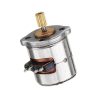
Hybrid stepper motors combine the features of both permanent magnet (PM) and variable reluctance (VR) types, offering improved performance in terms of resolution, torque, and speed. Most NEMA stepper motors fall into the hybrid category.
Understanding the NEMA Standard
NEMA stands for National Electrical Manufacturers Association. The NEMA standard defines the dimensions of the motor’s faceplate, mounting holes, and shaft size, but does not specify the electrical characteristics such as current, voltage, or torque. The number following the “NEMA” designation indicates the faceplate size in tenths of an inch.
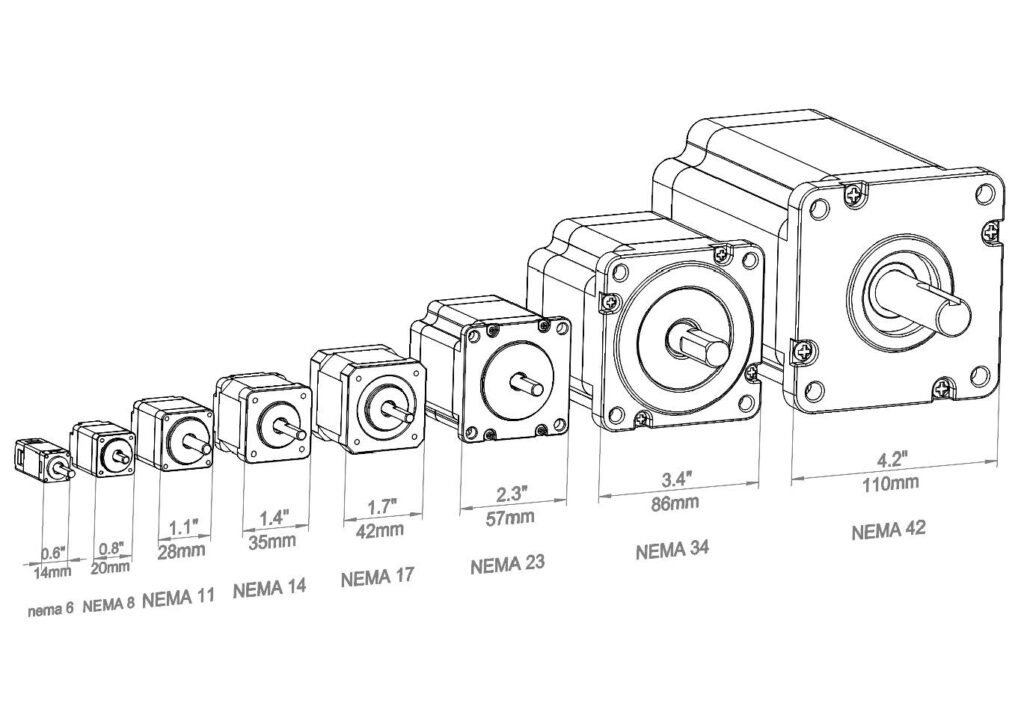
Common NEMA Sizes:
- NEMA 8: 0.8 inches (20 mm)
- NEMA 11: 1.1 inches (28 mm)
- NEMA 14: 1.4 inches (35 mm)
- NEMA 17: 1.7 inches (42 mm)
- NEMA 23: 2.3 inches (57 mm)
- NEMA 34: 3.4 inches (86 mm)
Among these, NEMA 17 is particularly popular in Consumer-Grade 3d printers and small CNC machines due to its balance of torque, size, and ease of integration.
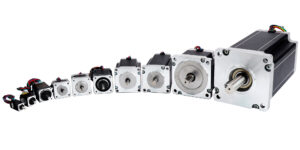
How Stepper Motors Work
Stepper motors have multiple coils Organised in phases. When Energised in a specific Sequence, these coils create a Magnetic field that forces the rotor to move in discrete steps. The motor’s internal construction determines the number of steps per revolution.
A standard hybrid stepper motor typically has 200 steps per revolution (1.8° per step), although higher-resolution motors with 400 steps (0.9° per step) are also available.
Stepper motors can be driven in several modes:
- Complete Step: The motor moves one complete step per pulse.
- Half Step: The motor alternates between full and half steps, improving resolution.
- Microstepping: The motor divides each step into many micro-steps (e.g., 1/16, 1/32), offering smoother motion and finer resolution.
Stepper motors can have different wiring configurations:
- Unipolar (5 or 6 wires): Has a centre tap on each coil, making it easier to drive but generally with less torque.
- Bipolar (4 wires): No centre taps; requires an H-bridge driver and provides better torque and efficiency.
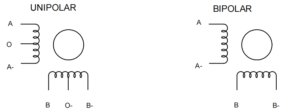
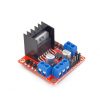
Most NEMA 17 motors are bipolar, 4-wire hybrid stepper motors, making them compatible with modern microstepping drivers, such as the A4988, DRV8825, and TMC2208.
Technical Specifications of NEMA Stepper Motors
The performance of a NEMA stepper motor varies by model, but key parameters to consider include:
- Step Angle: Typically 1.8° or 0.9°
- Holding Torque: Ranges from 20 N·cm to over 100 N·cm, depending on size and current
- Rated Current: Usually between1.0aA and 2.5a per phase
- Voltage: Typically low (2v to 5v), but it depends on the winding resistance and desired current
- Inductance: Affects how quickly the motor can respond to changes in input
Applications of NEMA Stepper Motors
NEMA stepper motors are found in various applications, such as:
- 3d Printers: For moving the X, Y, and Z axes and controlling the extruder
- CNC Machines: Used to move tools and workpieces with high precision
- Robotics: Enables precise movements for robotic arms and platforms
- Camera Sliders: Smooth panning and tilting
- Medical Devices: For accurate control in lab automation and imaging systems
Advantages of Using NEMA Stepper Motors
- Precision: Highly Accurate without needing Feedback (Open-loop)
- Repeatability: Reliable in performing the same movement repeatedly
- Ease of Use: Simple control logic and readily available drivers
- Modularity: Standardised sizes make it easy to replace or upgrade
- Affordability: Cost-effective for a wide range of projects
Limitations and Considerations
While stepper motors are versatile and easy to use, they also come with certain limitations:
- Resonance and Vibration: Especially at certain speeds
- Torque Drop-off: Torque decreases with increasing speed
- Heat Generation: Can become hot during continuous use
- Open-Loop System: No built-in feedback; position errors may go undetected
To overcome some of these limitations, designers may incorporate feedback mechanisms, such as encoders, or opt for closed-loop stepper motor systems.
Choosing the Right NEMA Stepper Motor
When selecting a NEMA stepper motor for your project, consider the following factors:
- Torque Requirements: Match the holding Torque to the load
- Physical Size: Ensure the motor fits within the Mechanical design
- Power Supply and Driver Compatibility: Match current and voltage ratings
- Resolution Needs: Choose step angle and microstepping accordingly
- Thermal Management: Allow for Adequate cooling if running at high current
Conclusion
NEMA stepper motors, particularly the NEMA 17 model, are integral to countless precision-driven applications. Their standardised design, precision control, and wide availability make them a go-to solution for engineers, hobbyists, and product developers alike. Understanding their operation, specifications, and appropriate usage is key to optimising performance in motion control systems. As technology advances, the capabilities of stepper motors continue to improve, ensuring they remain relevant in both emerging and established industries.